
The Next Step(s)
Your 8 most strategic next career steps.
Your steps to keep moving in a world that keeps on moving, step by step.
What it is
Career Strategy Essentials
200hrs+ of research condensed into 8 career exercises, leading you to your 8 most strategic next steps, based on proven methods and science.
Reviewed by 100+ professionals in IT, Finance and Consulting.
Their avg. rating? 4,2/5.

Career Strategy Essentials group session

LIVE motivation discovery

8 P’S OF WORK™ live workshop
What to expect
-
Find out what motivates you based on the 8 P’S OF WORK™ science-backed motivation model.
Outcome: your top three motivators and one strategic next action.
Sources
8 P’s of Work: designed by Otcho, inspired by the work of Maslow's Hierarchy of Needs: Maslow, A. H. (1943). A Theory of Human Motivation. Psychological Review, 50(4), 370-396. ; Herzberg's Two-Factor Theory: Herzberg, F., Mausner, B., & Snyderman, B. B. (1959). The Motivation to Work. Wiley. ; McClelland's Theory of Needs: McClelland, D. C. (1961). The Achieving Society. Free Press. ; Deci & Ryan's Self-Determination Theory: Deci, E. L., & Ryan, R. M. (1985). Intrinsic Motivation and Self-Determination in Human Behavior. Plenum Press. ; Reiss's 16 Basic Desires Theory: Reiss, S. (2004). Multifaceted Nature of Intrinsic Motivation: The Theory of 16 Basic Desires. Review of General Psychology, 8(3), 179–193. ; Pink's Work on Autonomy, Mastery, and Purpose: Pink, D. H. (2009). Drive: The Surprising Truth About What Motivates Us. Riverhead Books. ; Appelo's Moving Motivators (CHAMPFROG): Appelo, J. (2010). Management 3.0: Leading Agile Developers, Developing Agile Leaders. Addison-Wesley Professional.
-
Uncover why your top three P'S OF WORK™ (motivators) are currently driving you. Use those answers to uncover limiting beliefs.
Outcome: the root reasons for your top three motivators, two or three limiting beliefs and one strategic next action.
Sources
5WHY (technique): from the Toyota Production System (TPS), found thanks to Tim Ferris’ newsletter: ‘5-bullet Friday’ and inspired by the work of Viktor Frankl in ‘Man’s search for Meaning’ (idea).
Limiting beliefs: designed by Otcho based on client experiences since 2021.
-
Review and (re-)define your top eight definitions of success. Track your energy to uncover patterns in energy givers and takers.
Outcome: your eight definitions of success, your three most apparent energy givers and takers, one strategic next action.
Note: this session requires two weeks of five minutes per weekday in homework.
Sources
Success definitions: designed by Otcho, inspired by the work of Jay Shetty in ‘Think like a Monk’ (structure), Mark Manson in ‘The subtle Art of not giving a F*ck’ (idea), Hector Garcia & Francesc Miralles in ‘Ikigai’ (idea), Morgan Housel in ‘The Psychology of Money’ (idea) and Eric Jorgenson in ‘The Almanack of Naval Ravikant’ (idea)
Energy tracking: designed by Otcho, inspired by the work of James Clear in ‘Atomic Habits’ (scientific basis), Charles Duhigg in ‘The Power of Habit’ (scientific basis), Matthew Walker in ‘Why We Sleep’ (scientific basis), and Jay Shetty in ‘Think like a Monk’ (idea).
-
Collect data on your strengths and weaknesses. Decide which tasks to go all-in on (your strengths) and which tasks you could delegate (your weaknesses).
Outcome: your (MBTI/Clifton) personality type, your top three strengths and weaknesses, and one strategic next action.
Sources
Personality testing: designed by Otcho, inspired by the work of 16personalities (access to ‘MBTI: Myers-Briggs Type Indicator’), Eben Harrell in his Harvard Business Review article ‘A Brief History of Personality Tests’ (scientific basis), James Clear in ‘Atomic Habits’ (scientific basis), Daniel Kahneman in ‘Noise’ (scientific basis), and Eric Jorgenson in ‘The Almanack of Naval Ravikant’ (compounding).
Other personality tests that may be of interest: Clifton strengthsfinder, Big Five, Insights Discovery, DISC… Ask away if you prefer a different test.
-
Map your interests profile, or uncover hidden or forgotten interests. Choose between a science-backed interests test or a creative bookstore exercise.
Outcome: your top three interests or interest fields, one strategic next action.
Sources
Interests map: Holland Codes, the only scientifically validated interests test.
Bookstore: often recommended exercise in personal development sphere, found thanks to Cal Newport’s ‘Study Hack Blog’ (idea).
-
Answer the opposite question of “What is your dream job?”. Instead we tackle: “What are you willing to suffer for?”.
By synthesizing your answers from exercises one to five, we build a dream and reality grid to find patterns in your preferences.
Outcome: your dream grid, your reality grid, and an answer on what you are willing to give up on to achieve x. One strategic next action.
Sources
Sync & Suffer: designed by Otcho, inspired by the work of Mark Manson in ‘The subtle Art of not giving a F*ck’ (idea), and ‘thematic analysis’ as a form of qualitative data analysis (technique).
-
Decide which values to follow when outcomes are unclear and multiple next steps are possible.
Outcome: your seven values, one bonus value, and one strategic next action.
Sources
Personal values: designed by Otcho, inspired by the work of James Clear in his blog ‘Core Values List’ (examples of values), Mikayla Balk in her blog ‘30 personal values examples & how to live by yours’ (examples of values), Lyn Christian in her blog ‘Defining Your List of Values and Beliefs (With 102 Examples)’ (examples of values), Scott Jeffrey in his blog ‘The Ultimate List of Core Values (Over 230)’ (examples of values), and Mark Manson in ‘The subtle Art of not giving a F*ck’ (value criteria).
-
Because we forget up to 70% of what we learned within the first 24 hours (Ebbinghaus), we use the science of visualization to conclude on your core insights and eight most strategic next steps.
Outcome: visual reminder board with your personal and professional identity, an overview of your eight most strategic next steps.
How it works
1/ Secure your 8 sessions

There are eight 1:1 sessions of one hour. You walk away with one strategic next step per session. This can be done online (recommendation: 1h/week) or on site (2 × 0.5d).
2/ Define your 8 strategic next steps

We build your eight most strategic next steps throughout the sessions. We end the process with an overview (to do / doing / done) and a visual reminder board of your identity.
3/ Receive personalized book
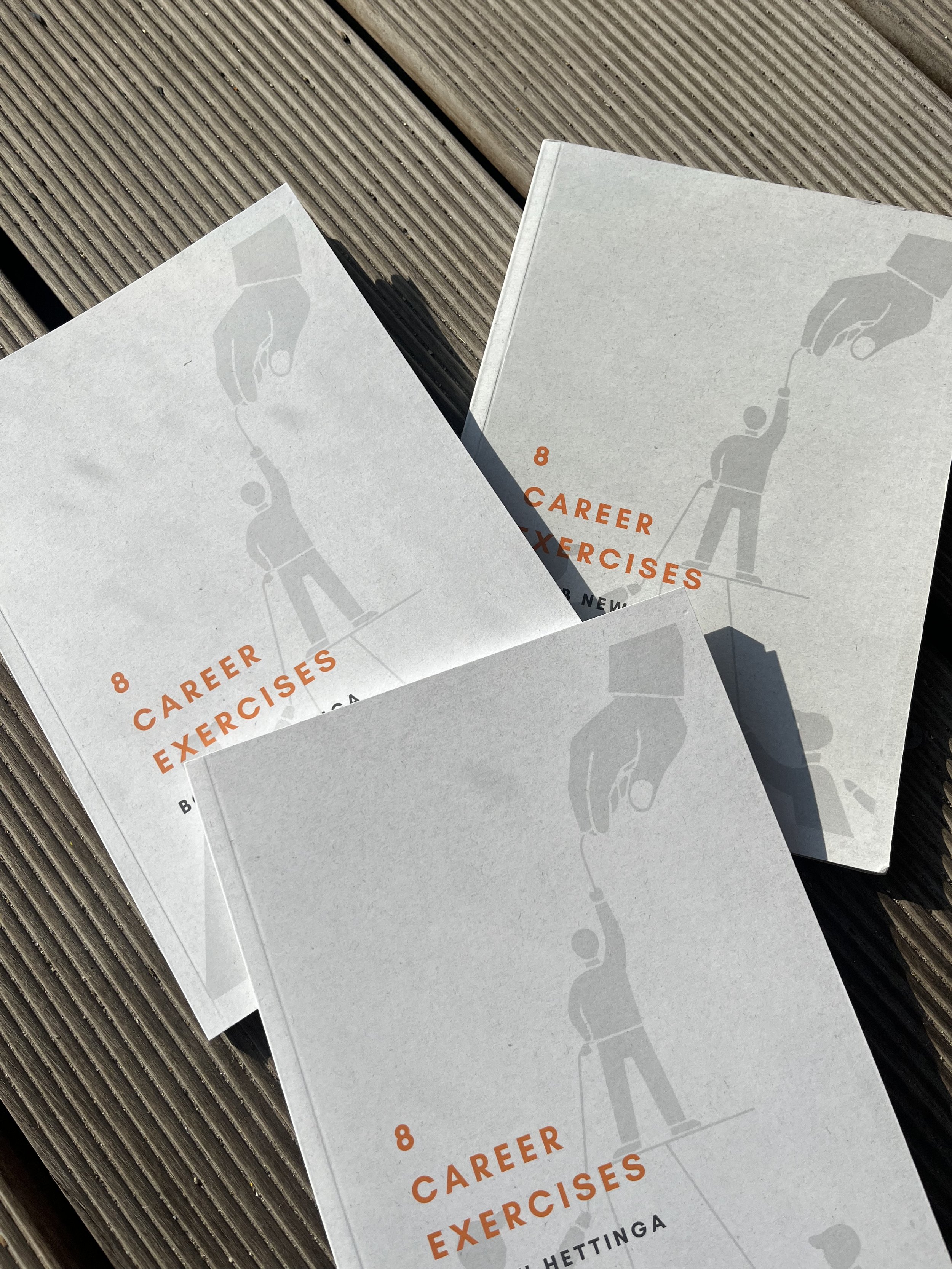
Your answers are printed in a personalized book, giving you lifetime access to the instructions. This way, you can repeat the process whenever you desire and continue to build.